





TL;DR: Choosing the right UX design agency starts with knowing your goal: improve product UX, fix onboarding, or rethink the product entirely. Look beyond portfolios — evaluate process, research rigour, and how they think. The best agencies act like partners with skin in the game, not contractors with a scope of work. Run a paid discovery sprint before committing to any long engagement.
If you're wondering how to choose a UX design agency, you're not alone. Hiring a UX design agency might be one of the highest-leverage decisions your business makes this year.
Done right, it can transform how your users experience your product by reducing friction, building trust, and turning confusion into clarity. Done wrong, it costs you months, money, and momentum you can't recover easily.
The difference between a transformative UX agency and a forgettable one rarely shows up in the visuals of the portfolio alone. It lives in how they think, how deeply they commit to your problem, and whether they're the kind of partners who carry your vision or just execute it.

1. Start With Clear Product Goals Before Hiring a UX Design Agency
Before you brief a single agency, get honest about what you're actually trying to solve. 'Improve UX' is a direction, not a brief. The agency best suited to help you redesign a product from scratch is rarely the same one that excels at untangling a specific onboarding drop-off. Knowing the difference will save you weeks of misaligned conversations.
Common UX engagement types include:
- Full product redesign: rethinking flows, architecture, and experience from the ground up
- Improve product UX: targeted work on specific friction points causing drop-off or disengagement
- Improve onboarding UX: reducing time-to-value and increasing early activation
- Brand and experience alignment: making the product feel coherent with your wider identity
- Design system creation: building scalable, consistent component libraries
- New product design: defining the UX for something that doesn't exist yet
Write a one-paragraph problem statement before you approach any agency. What is the product, who uses it, what isn't working, and what does success look like in 6 months? The agencies worth hiring will read it carefully. The ones who respond with a generic capabilities deck probably didn't.

2. What to look for in an UX Design Agency Portfolio?
A polished portfolio is expected. What separates great agencies from good ones is what lives behind the work, the reasoning, the process, and whether the outcomes were real.
When reviewing a product redesign agency's past work, resist the pull of aesthetics and ask harder questions:
- What problem were they solving and how did they figure out what it actually was?
- Are there measurable outcomes?
- Does the work feel like the obvious solution, or just an impressive one?
- Have they built for users and contexts that resemble yours?
If a portfolio is full of visually striking pieces that feel designed for an awards jury rather than a real person under real pressure, notice that.
Don’t look for the most creative agency. Look for the most clear-headed one.
At Sparklin, we truly believe in being ‘Strategic by Design’, which means nothing we do is ornamental. Every detail earns its place. From typography to timing, every choice serves the brand's truth and the business's ambition.
3. Why the Discovery Process Matters in a UX Design Project
The single biggest differentiator between agencies that genuinely improve product UX and those that improve product aesthetics is how seriously they treat discovery: the research and diagnostic work that happens before any design begins.
A rigorous UX agency will want to understand the full system before they touch any part of it. That means:
- Interviewing your actual users, not just your internal team's assumptions about them
- Auditing analytics, session recordings, and support tickets before opening a design tool
- Mapping current user journeys to find where value is leaking
- Understanding your business model and how experience connects to revenue and retention
- Running usability tests on what exists today before proposing what comes next
Green Flag vs. Red Flag
Green flag: 'We spend the first few weeks in discovery before we design anything.'
Red flag: 'We can have initial concepts to you by next Friday.'
Every hour cut from discovery gets borrowed from somewhere else; usually from a redesign sprint three months later, when the stakes are higher and the timeline is shorter. Every assumption left unchecked in week one becomes a redesign conversation in week six, and a missed opportunity to genuinely improve product UX.
The best UX design agencies go after what nobody wrote in the brief. The behaviour pattern that doesn't match the data. The constraint that only surfaces once you talk to real users. That's where a good product redesign agency earns its place.
4. Look for Strong Onboarding UX Expertise
If improving onboarding UX is any part of your goal (for most products it should be near the top of the list), make sure the agency you hire has specific, demonstrable experience here.
Onboarding is one of the most technically complex UX problems to solve well. It requires balancing activation speed, feature discoverability, progressive disclosure, and emotional motivation, all within the window when new users are most likely to give up. Getting it right demands empathy over cleverness: meeting users where they actually are, not where you hope they'll be.
The best agencies treat onboarding as a product strategy problem, not just a UX problem. They think about the emotional arc of a first-time user: what people need to feel and design accordingly.
5. How Great UX Agencies Balance Speed and Quality
One of the most revealing questions you can ask any agency: how do you decide when to move fast, and when to slow down?
The right answer is: it depends and a good agency will tell you exactly what it depends on.
Speed matters in UX. Long design cycles that run disconnected from real users produce work that misses the point, no matter how refined it looks. But moving fast blindly without depth, without validation, without the willingness to hold ground when quality demands it, just produces expensive noise.

The agencies worth hiring have developed the judgment to know which moments call for urgency and which call for patience. They act quickly where speed creates clarity. They slow down where rushing creates debt. And they can explain that distinction because they've earned it through experience.
6. Evaluate How the UX Design Agency Collaborates With Your Team
At Sparklin, we firmly advocate for measuring the success of a project by what the client team can do after we have done the final handover of each project. For us and for our clients, the collaboration model matters as much as the design quality. An agency that produces excellent work in isolation but creates friction with your existing team will quietly erode the value of everything they build. Sparklin has an inbuilt Co-Founder DNA. The vision you have becomes the one we carry. The problems you face become the ones we solve. We move with care, clarity, and commitment, not as outsiders, but as the kind of partners who treat your business like our own.
Before signing anything, get specific answers to:
- Who exactly will work on our project?
- How do you collaborate with our internal product, marketing, or engineering teams?
- What does handoff look like and do you support implementation questions after delivery?
- How do you handle scope changes or a brief that evolves mid-engagement?
- What do we own at the end: files, systems, knowledge?
7. Choose a UX Design Partner That Thinks Strategically
There's a meaningful difference between an agency that designs what you ask for, and one that designs what your business actually needs. The best UX agencies operate at the intersection of product thinking, brand strategy, and human behaviour.
In early conversations, notice whether the agency talks about pixels and deliverables, or about intent, belief, and behaviour. Both matter. But the sequence matters more. At Sparklin we believe that strategy should always precede aesthetics because every visual decision is also a business decision, whether you treat it that way or not.
Ask the agency you are choosing: how does design connect to business outcomes in your process? The agencies that can answer that clearly, concretely and without jargon are the ones who have actually done it.
8. Find an Agency That Thinks Ahead
Choosing a UX partner isn't just about solving today's problem. Your product will evolve. Your users will change. The context your product exists in will shift sometimes faster than you expect.
The agencies worth building a long-term relationship with have a point of view on where things are heading. At Sparklin, we explore relentlessly, build on our own instincts and create before the world realizes it's ready. Because the future isn't predicted. It’s designed with intent and taste.
Look for agencies that publish original thinking. They have perspectives on design, technology, and behaviour that feel genuinely considered. An agency that only knows how to solve problems that already exist will struggle when you need to build something that doesn't exist yet.
UX Design Agency vs In-House UX Team vs Freelancers
When teams start thinking about improving product UX or redesigning key user journeys, the next question is who should do it.
Should you build an in-house UX team, hire freelancers, or partner with a UX design agency? Each option comes with different strengths depending on the complexity of your product, the speed you need, and the depth of research and strategy required. For large redesigns, onboarding UX improvements, or enterprise products, many companies choose a UX design agency because it brings together research, strategy, design, and cross-industry experience under one roof.
The comparison below breaks down how these three approaches differ across critical factors like expertise, scalability, cost, and speed.
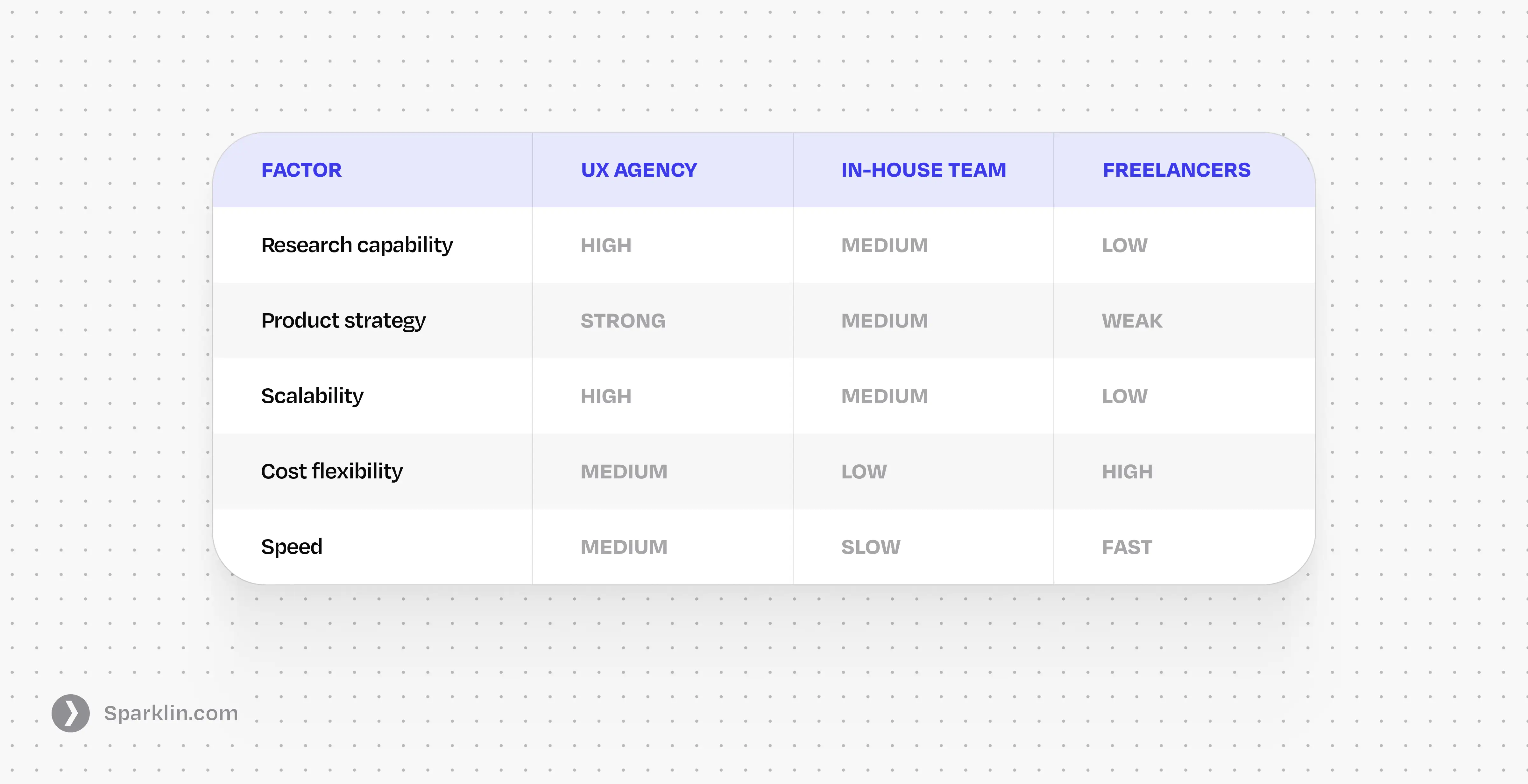
For complex product redesigns or onboarding improvements, UX design agencies often provide the strongest balance between research depth, strategic thinking, and execution speed.
The Right Agency Treats Your Goals as Their Own
Ultimately, learning how to choose a UX design agency comes down to identifying partners who understand your product, your users, and your long-term business goals.
The agencies that genuinely change things don't operate like vendors with a scope of work. They show up like partners with skin in the game, carrying your vision with care, moving with urgency when it matters, and holding their ground when quality demands it.
They ask harder questions than you expected in the first meeting. They push back when your brief needs it. They talk about your users with the same urgency you do, sometimes more. They don't confuse speed with progress, or visual polish with real impact. And the work they produce doesn't beg for attention. It earns it.
That kind of partnership is rare. But it exists. And now you know exactly how to find it.
