



TL;DR
Agencies bring structure, specialized teams, and long-term reliability. Freelancers offer flexibility and lower upfront costs.
For projects where user experience directly affects revenue, conversion, or retention, hiring a UX design agency is often the safer investment. For smaller, clearly defined work, a freelance UX designer can be an efficient and cost-effective choice.
UX Agency vs Freelancer: The Decision That Shapes Your Product Experience
Sooner or later, every product team asks the same question: Should I hire a UX agency or bring in a freelance UX designer?
At first glance, the UX agency vs freelancer debate seems simple. Agencies are larger and more structured. Freelancers are flexible and independent. But once budgets, timelines, and product complexity enter the picture, the decision becomes more nuanced.
Choosing incorrectly can slow down development, create misalignment between teams, or lead to expensive redesign cycles. This is why the question of hiring a UX designer vs agency is less about preference and more about understanding what your product actually needs.
Both models work well in the right circumstances. The goal is to understand how UX design agency vs freelance designer engagements differ so you can match the right resource to your project.
For many companies, the decision between a UX design agency vs freelance designer ultimately comes down to one goal: finding the most effective way to improve product UX without slowing down development or increasing operational complexity.
What You Actually Get When You Hire a UX Design Agency
Working with a UX design agency means buying into more than just design hours. Most established agencies operate as a coordinated team of specialists. A typical UI UX design agency includes researchers, interaction designers, visual designers, strategists, and project managers who collaborate across projects every day.
That collective experience often changes how problems are approached and solved.
A Team That Has Already Figured Out How to Work Together
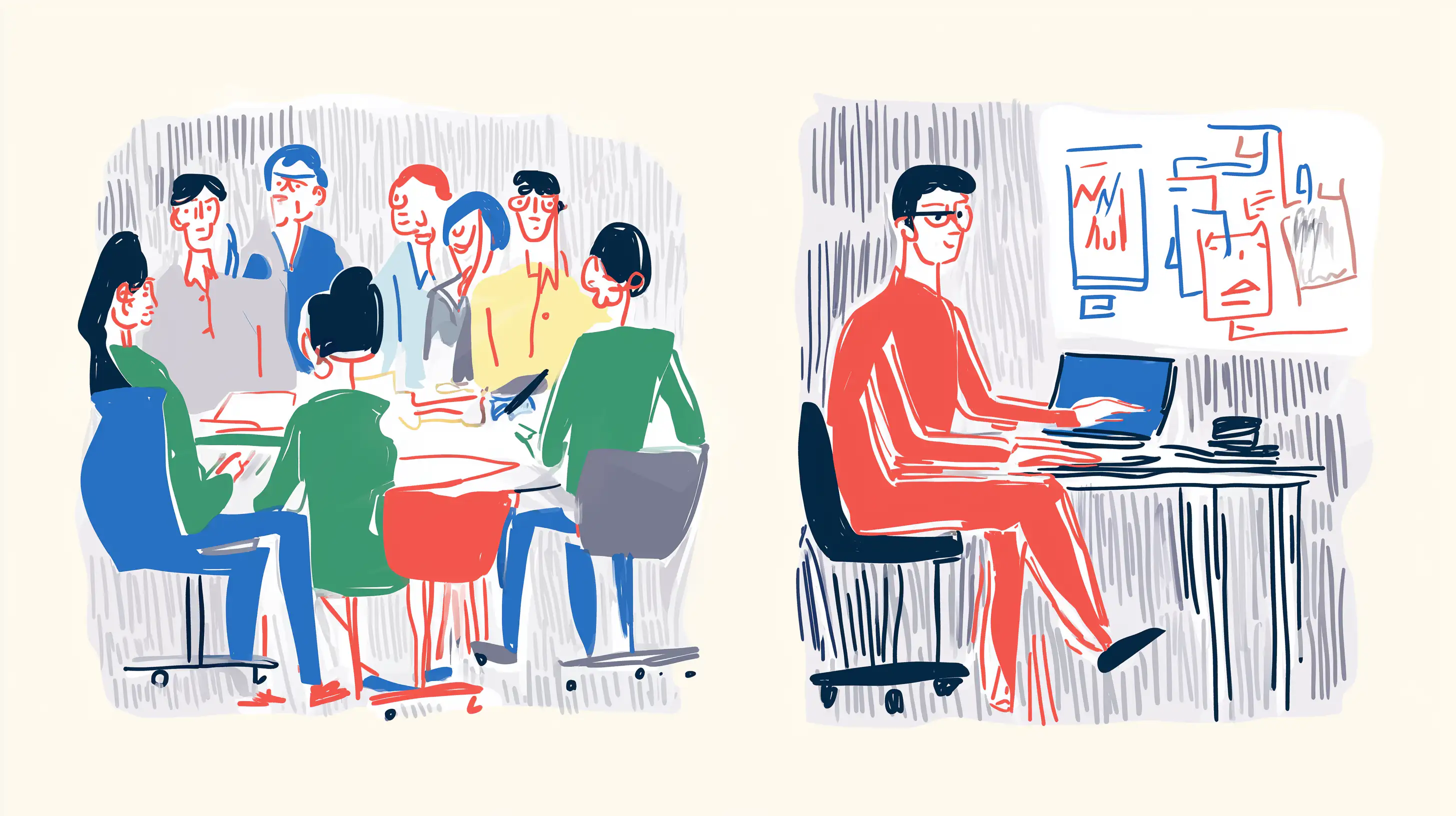
One hidden challenge in freelancer vs agency design decisions is collaboration overhead. When you hire multiple freelancers, you often end up coordinating people who have never worked together before. Aligning workflows, resolving handoff issues, and maintaining consistency can quickly become your team’s responsibility.
A product design agency removes much of that friction. The team already has established processes, shared tools, and internal communication rhythms. Instead of managing individuals, you focus on the outcomes the agency is delivering.
Accountability at the Organizational Level
When you work with a single freelance UX designer, accountability typically rests with that individual. If timelines slip or communication breaks down, there is little structural backup.
A UI UX design agency, by contrast, operates with layers of accountability. Project managers, account leads, and internal review systems help ensure work stays aligned with the brief and timelines stay realistic. This organizational structure often makes agencies a safer choice for complex or high-risk projects.
Institutional Knowledge That Carries Over
A strong product design agency builds documentation, design systems, and internal knowledge about your product over time. If one designer rotates off the project, another team member can step in without losing context.
With freelancers, that context often lives with the individual. If they move on, much of that knowledge goes with them.
Access to Research and Strategy Infrastructure
Good UX decisions are rarely based on intuition alone. Real user research requires recruiting participants, managing sessions, synthesizing insights, and translating findings into design decisions.
Many UX design agencies already have systems for this work. Independent designers can certainly run research as well, but the infrastructure is not always built into their workflow.
Agencies Bring Cross-Disciplinary Experience
Another advantage agencies bring is the range of situations they have already encountered. Because they work with multiple clients across industries, they accumulate patterns that a single product team might not yet have experienced.
For example, a company might not be thinking about a go-to-market strategy today. But an agency that has worked on similar products may anticipate how onboarding, pricing flows, or feature discovery will need to evolve once that stage arrives. This perspective often influences how the UX is structured early on, making it easier to adapt when the product grows or the business model changes.
Why Teams Often Hire a UX Agency
Product teams typically choose an agency when their needs extend beyond individual design tasks.
Common reasons include:
- The project requires multiple skill sets, such as research, interaction design, content, and usability testing
- Timelines are strict and delays could affect product launches
- The team wants a single point of accountability
- The engagement needs to continue even if individual contributors change
- Strategic thinking and product guidance are as important as design output
In these situations, hiring a UX design agency or product design agency can reduce operational complexity for the internal team.
When a Freelance UX Designer Is the Better Choice
Despite the advantages of agencies, freelancers are far from a compromise. In fact, for certain types of work, a freelance UX designer may be the more efficient option.
Understanding where freelancers excel helps clarify the product design agency vs freelancer comparison.
Speed on Contained, Well-Defined Work
If your project scope is narrow, for example, redesigning a specific user flow or creating high-fidelity screens from existing wireframes, a freelancer can often move faster.
Without additional coordination layers, decision-making becomes simpler. A skilled freelance UX designer can deliver focused work quickly when the brief is clear.
Cost Efficiency for Smaller Budgets
One reason companies consider UI UX design agency vs freelancer comparisons is cost. Agencies carry operational overhead, including management roles, tools, and infrastructure.
Freelancers operate with lower overhead, which often translates to lower day rates. For startups with limited budgets, working with a freelancer can provide access to experienced design talent without the financial commitment of an agency.
Flexibility for Early-Stage Products
Startups in the exploration phase often do not know exactly what they need. A freelancer can engage on a more exploratory basis, shift focus as priorities change, and disengage without the contractual complexity of a larger agency relationship.
Freelancers Often Bring Deep Craft Expertise
Freelancers are often exceptional at their craft. Many spend years refining specific skills such as interaction design, prototyping, or visual systems. That depth of focus can produce very thoughtful work.
At the same time, freelancers usually work alone. They may not always have the advantage of daily collaboration with researchers, strategists, or other designers. Agencies, on the other hand, bring people from different disciplines into the same conversation. That mix of perspectives often leads to ideas that emerge through discussion, critique, and brainstorming rather than individual exploration.

UX Agency vs Freelancer: Where the Real Differences Appear And Things Get Complicated
Cost Is Not What People Think It Is
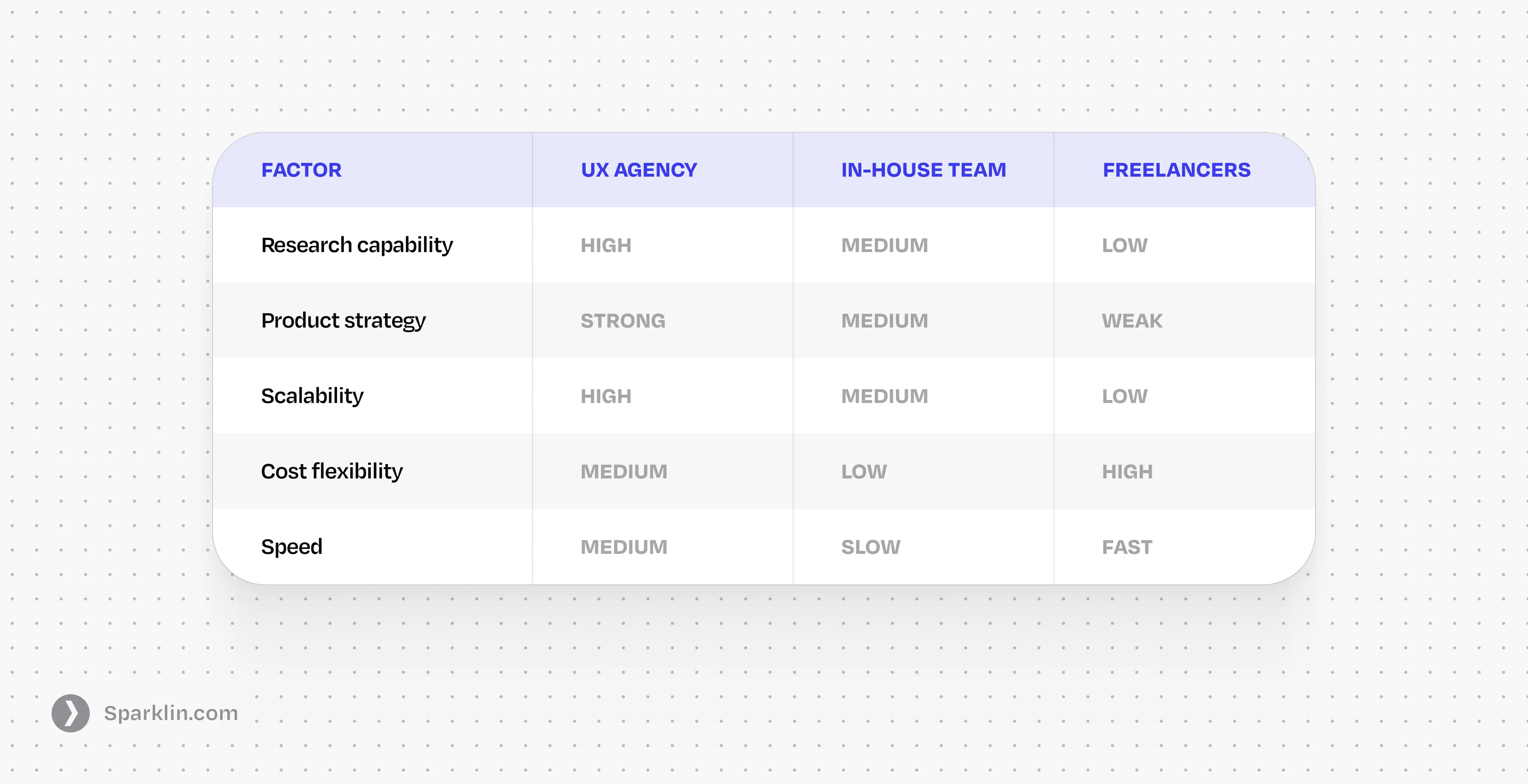
The agency quote looks higher on day one. That is true. But the full cost picture is more nuanced. With a freelancer, someone on your team is doing project management, reviewing work for quality, handling re-briefs when things go sideways, and filling in skill gaps. That time has a cost. A good agency absorbs most of that.
For projects over three months, the total cost of a managed agency engagement and a self-managed freelancer team tends to converge. For complex, multi-disciplinary projects, agencies often come out cheaper when you account for internal time spent managing the work.
Quality Is About Vetting, Not Category
Exceptional freelancers exist. So do mediocre agencies. Quality has nothing to do with whether someone works independently or within a firm. Where they do differ is the floor. Agencies have quality control processes, peer review, and real reputational skin in the game. That raises the minimum. Freelancer quality has a much wider range, which puts the burden of vetting squarely on you.
Communication Looks Different
With a freelancer, you get direct access to the person doing the work. That can be efficient and refreshing. With an agency, you often talk to an account manager or project lead who then translates to the team. That layer can add latency, but it also filters and organizes communication in ways that reduce your cognitive load.
The right choice depends on how much bandwidth your team has to manage an external relationship. If you have a dedicated product manager who can stay closely involved, a freelancer works. If UX is being managed on top of other responsibilities, the agency's structure carries its weight.
How to Decide: Framework For Hiring a UX Agency or a Freelancer
Rather than defaulting to one or the other, run your project through these questions before deciding.
- How many skill sets does this project need? If the answer is more than two, lean toward an agency.
- How much internal capacity do you have to manage the relationship? If the answer is limited, an agency's project management is worth the premium.
- What is the risk if this fails or delays? Higher risk projects benefit from organizational accountability.
- Is the scope clearly defined? Clearly defined, contained work suits freelancers. Ambiguous, evolving work suits agencies.
- What is your runway? Early-stage companies with tight budgets may need to start with a freelancer and grow into an agency relationship.
The Mistake Most Teams Make
Interestingly, many teams pick the correct category in the UI UX design agency vs freelancer debate but still struggle with the outcome.
Agencies sometimes fail when they are treated like execution vendors instead of strategic partners. Without access to user insights or product context, even strong teams cannot produce meaningful design work.
Freelancers, on the other hand, often struggle when expectations resemble full-time employment. Without clear briefs and decision processes, independent designers can become stuck in endless revisions.
In both cases, the working relationship matters as much as the resource model.
When Companies Start Looking for a UI UX Design Agency
At a certain stage of product growth, many companies move beyond the UX agency vs freelancer question and start evaluating long-term design partners.
This is especially true for teams building complex digital products across web and mobile platforms. Instead of hiring individual contributors for short engagements, they begin working with a UI UX design agency that can support research, design systems, usability testing, and continuous product improvement.
For companies operating in fast-growing digital markets, working with an experienced UI UX design agency in India, like Sparklin, has become increasingly common. India has developed a deep ecosystem of product design talent, and many agencies now partner with startups and global companies to redesign platforms, improve onboarding experiences, and simplify complex product workflows.
When design becomes a continuous function rather than a one-off task, the structure of an agency often becomes more valuable than the flexibility of a freelancer.
How to Evaluate a UX Design Agency Before You Hire One
If your conclusion from the UX agency vs freelancer decision is that an agency makes more sense, the next question becomes obvious: how do you choose the right one?
The quality of a UX design agency can vary widely. Some agencies focus on visual design execution, while others operate as full product design agencies that combine research, strategy, and interaction design.
Before you hire a UI UX design agency, it helps to evaluate a few core factors.

Look Beyond Visual Portfolios
Many agencies showcase polished UI screens. While visual quality matters, strong UX work is usually invisible.
Ask how the agency approaches user research, usability testing, and problem framing. A strong product design agency will explain how it understands user behaviour before jumping into design solutions.
Understand Their Discovery Process
Great UX rarely starts with screens. It starts with understanding users, product goals, and technical constraints.
A credible UX design agency should be able to describe how it runs discovery workshops, stakeholder interviews, and user research before beginning design work.
Evaluate Cross-Disciplinary Capabilities
Products rarely succeed because of UI alone. They require research, interaction design, content strategy, and usability testing working together.
A mature UI UX design agency usually brings these capabilities together within the same team.
Look for Evidence of Product Thinking
The strongest agencies behave less like vendors and more like product partners. Instead of simply executing instructions, they challenge assumptions and help teams rethink product flows.
This kind of collaboration often becomes the biggest advantage of working with a product design agency rather than managing individual freelancers.
Final Thoughts
Ultimately, the UX agency vs freelancer decision comes down to scope, risk, and internal capacity.
A UX design agency offers structured teams, broader expertise, and stronger accountability. A freelance UX designer offers flexibility, faster onboarding, and lower initial costs.
For complex products where user experience influences revenue or retention, many companies eventually choose to hire a UX agency or product design agency to ensure consistent progress. For contained tasks or early-stage experimentation, freelancers remain a powerful option.
Understanding the real differences between UX design agency vs freelance designer engagements allows product teams to choose the model that best supports their goals rather than simply choosing the cheapest or most convenient option.
If you are choosing between the two right now, start with scope and risk. Everything else follows from there.