




Marketing gets you leads today. Branding ensures those leads trust you enough to buy and keep buying. Strong branding makes every marketing effort more efficient over time.

TL;DR
Branding is who you are: your identity, values, and the emotional connection you build with customers. Marketing is how you tell people about what you do and drive immediate action. While marketing generates leads, branding reduces acquisition costs, increases customer lifetime value and makes your marketing more effective. Without branding, marketing has to work much harder to achieve the same results.
If you've ever heard "Why spend on branding when we can just run more ads?" you're not alone. It's one of the most common objections business leaders face when building their growth strategy.
The confusion is understandable. Both branding and marketing live under the same umbrella of business growth. Both require investment. And on the surface, marketing seems to deliver faster, more measurable results.
But here's what that perspective misses: companies that treat branding as optional pay a hidden tax on every marketing campaign they run.
When your brand is weak, every click costs more.
A company that doesn’t have strong branding pays more per lead, struggles with customer retention, and watches competitors with strong brands win deals at higher prices.
This article breaks down exactly what branding and marketing are, how they differ, why both matter, and how to invest in each strategically.
Does Branding Fall Under Marketing?
The short answer: No. Branding doesn't fall under marketing. They're parallel disciplines that support each other.
What Is Branding?
Branding is the foundation that defines who you are as a company. Far more than a logo, color palette, or tagline, branding is the sum total of emotions, associations and perceptions people have when they think about your business. It encompasses your values, positioning, personality, and promise, defining the emotional territory you own in customers' minds. Unlike a campaign, branding has no end date and is woven into every aspect of your business.
Core elements of branding include:
- Identity: Your mission, vision, values, and personality
- Positioning: How you differentiate from competitors in customers' minds
- Promise: What customers can consistently expect from you
- Visual and verbal identity: Logo, colors, typography, tone of voice, messaging
- Customer experience: Every touchpoint someone has with your business
- Reputation: What people say about you when you're not in the room
Branding answers the question: Who are we?
Apple’s branding, for example, is about innovation, simplicity, and thinking differently. According to analysis by Kantar, strong brand associations allow the iPhone to command a 40% price premium over competitors like OnePlus despite similar technical specifications. Apple’s brand allows them to charge premium prices and maintain fierce customer loyalty across decades.
What is Marketing?
Marketing is tactical and time-bound. It's the active execution that drives awareness, generates leads, and converts customers. It includes campaigns, advertisements, email sequences, social media posts, SEO efforts, and lead generation activities, each with clear start and end dates, measurable KPIs, and specific conversion goals. Where branding defines who you are, marketing is the ongoing process of promoting your products or services to your target audience through specific channels and initiatives.
Core elements of marketing include:
- Strategy: Target audience, positioning, messaging, channels
- Campaigns: Specific initiatives with defined goals and timelines
- Content: Blogs, videos, social media posts, emails, ads
- Distribution: SEO, PPC, social media, email, events, partnerships
- Conversion optimization: Landing pages, CTAs, sales funnels
- Measurement: Analytics, KPIs, ROI tracking
Marketing answers the question: How do we reach people and drive action?
Think of a New Balance collaboration on social media promoting new running shoes. That's marketing, designed to drive awareness and sales of a specific product at a specific time.

What is the Difference Between Marketing and Branding?
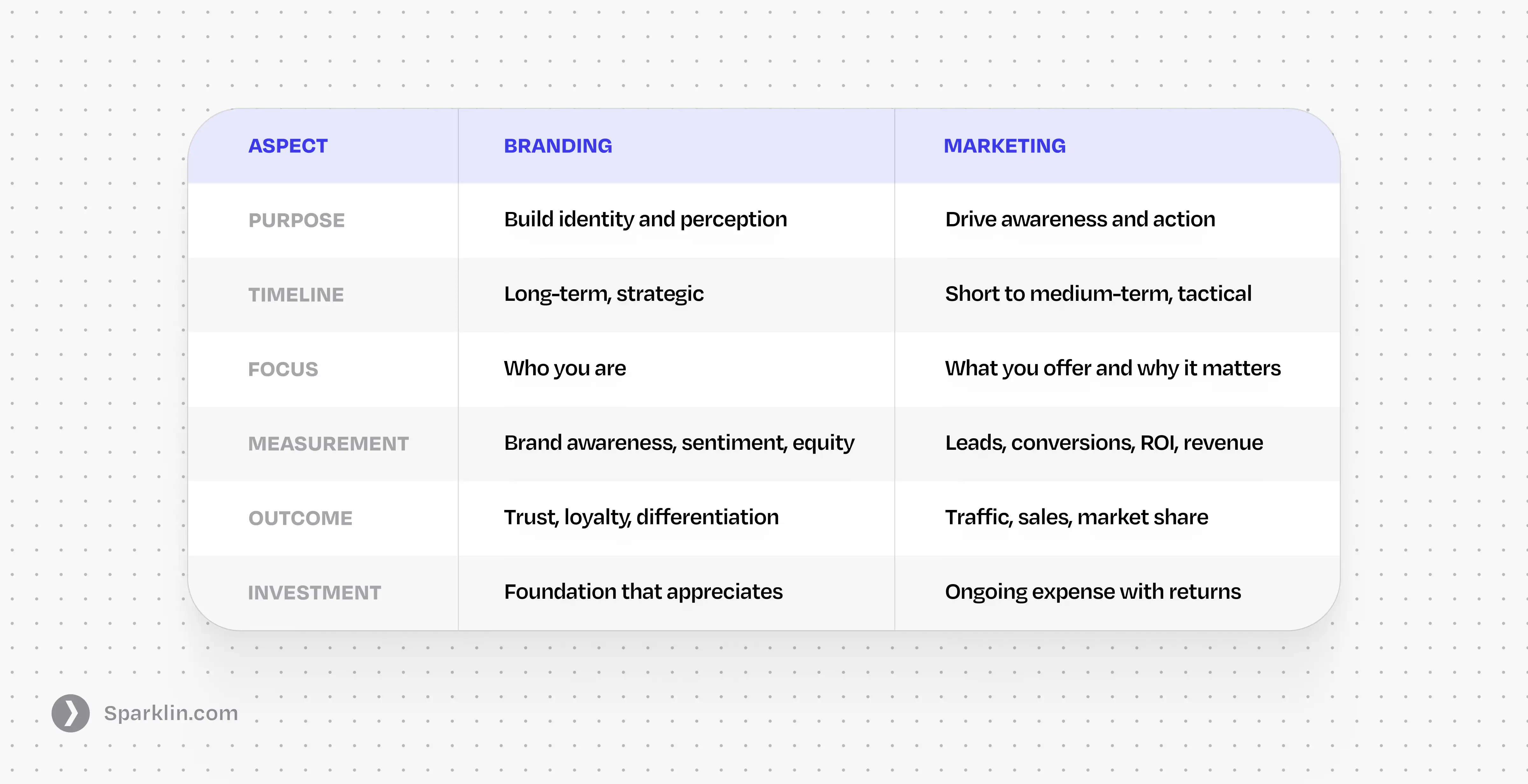
The relationship: Branding is the stage; marketing is the performance. Strong branding makes marketing more effective and less expensive. Weak branding means you're constantly shouting louder just to be heard.
What Comes First: Branding or Marketing?
Branding should come first. Before launching marketing campaigns, you need to establish your brand foundation, which consists of your positioning, values, differentiation, and core messaging. This doesn't mean waiting months for brand perfection, but rather creating what's called a Minimum Viable Brand (MVB) that includes clear positioning, defined values, basic visual identity, and consistent messaging. This foundation typically takes 2-4 weeks for small businesses and 1-3 months for larger organizations.
Marketing without a brand foundation is like shouting into a crowd without knowing what you're trying to say or who you're trying to reach. Without clear answers to "Who are we?", "What makes us different?" and "What do we stand for?" your marketing will lack direction, consistency, and differentiation. Companies that rush into marketing first typically experience inconsistent messaging, wasted ad spend, brand confusion, and difficult pivots when they need to change direction.
The hierarchy looks like this:
- Brand Strategy (who we are, what we stand for, how we're different)
- Marketing Strategy (how we communicate that to target audiences)
- Marketing Tactics (specific campaigns, channels, and executions)
When companies treat branding as just another marketing tactic something to "do" when launching or "refresh" periodically, they miss its strategic power. Strong branding makes marketing more effective, reduces customer acquisition costs, and builds long-term enterprise value that survives any single marketing campaign.
Why "Just Do Marketing and Skip Branding" Doesn't Work
Let's address the elephant in the room: "Marketing gives us leads now. Why spend months on branding that doesn't directly generate revenue?"
Here's what happens when you skip branding and focus only on marketing:
1. Higher customer acquisition costs (CAC)
Without brand recognition, every customer needs to be convinced from scratch. You're competing purely on price or features, which means expensive ad campaigns and aggressive discounting.
Performance marketing increases reach. Branding improves the efficiency of that reach over time.
2. Lower conversion rates
People buy from brands they trust. If prospects have never heard of you and you haven't built credibility, your conversion rates suffer; no matter how good your marketing is.
3. Price sensitivity
Weak brands compete on price. Strong brands command premium pricing because customers perceive higher value. Nike's Air Jordan and Air Max lines are priced significantly higher than many of the brand's other shoes, creating an aura of exclusivity, with Air Jordans retailing at $190 while similar quality shoes from competitors sell for much less.
4. Poor customer retention
If customers don't connect with your brand emotionally, they'll leave for any competitor with a better deal. Harvard Business Review Research shows that acquiring a new customer is anywhere from five to 25 times more expensive than retaining an existing one.
5. Marketing fatigue
Without a strong brand foundation, you have to scream louder than your competitors. Your messaging becomes generic, your differentiation unclear, and your marketing ROI decreases over time.
Real-world example: Consider how Coca-Cola maintains pricing power through brand strength. In the US, 2 litres of Coca-Cola costs about $1.80 at Walmart, but 2 litres of Sam's Cola is less than a dollar. Many consumers willingly pay the premium because of Coca-Cola's brand equity, not because the product is fundamentally different.
The Real Reason Companies Underinvest in Branding
In many companies, brand management sits within the marketing department for administrative convenience and this structural decision alone perpetuates the confusion. Because branding is harder to measure in the short term, most companies default to what they can track: clicks, leads, and immediate conversions.
But this creates a dangerous bias. Budgets flow toward activation because they feel accountable. Brand building feels abstract. Over time, however, this short-term bias makes marketing more expensive because when customer acquisition costs keep rising year after year, the problem is rarely channel efficiency. It's usually a brand weakness.
Strategically, branding should inform marketing, not the other way around. Your brand strategy should be defined at the executive level and then serve as the guiding foundation for all marketing activities.
Why Should Brands Feel More Human Than A Corporate
Trust in brands does not form the way trust in numbers or reports does. It forms the way trust in people does: slowly, through repeated behavior, emotional consistency, and a sense of character over time. We rarely trust a company because it claims to be reliable. We trust it because, over multiple interactions, it behaves in ways that feel coherent and familiar.

Walt Disney grasped this long before modern brand theory gave it language. When his teams developed characters like Mickey Mouse or Donald Duck, they began with personality before approaching the drawing board. How would the character react under stress? What irritated them? What made them joyful? Only after defining this internal logic did the drawing follow. The idea was clear: if the behavior feels real, the form will feel believable.
Over time, this consistency does something more powerful than just building likability. It builds mental preference. The strongest brands win by becoming the instinctive choice long before the decision moment arrives. At Sparklin, we describe this as a Mental Market Monopoly: a state where a brand occupies such a stable and familiar space in the mind that alternatives barely register. The decision does not feel like a comparison. It feels like a default.

You can observe this in everyday language and behaviour. People now Google instead of searching online. Do a Zoom Meeting at work instead of a video call. Photoshop an image instead of editing it. WhatsApp instead of sending a message.
In each case, the brand has moved beyond being one option among many. It has become the mental shortcut. And that shortcut is built through years of recognisable behaviour that makes the brand feel less like a company and more like a dependable presence in people’s lives. Constant marketing can embed these brands in people’s life, but a good branding lays the foundation for marketing to work.
Why Both Branding and Marketing Matter
For the most successful companies, branding and marketing aren’t either–or—they work as one system.
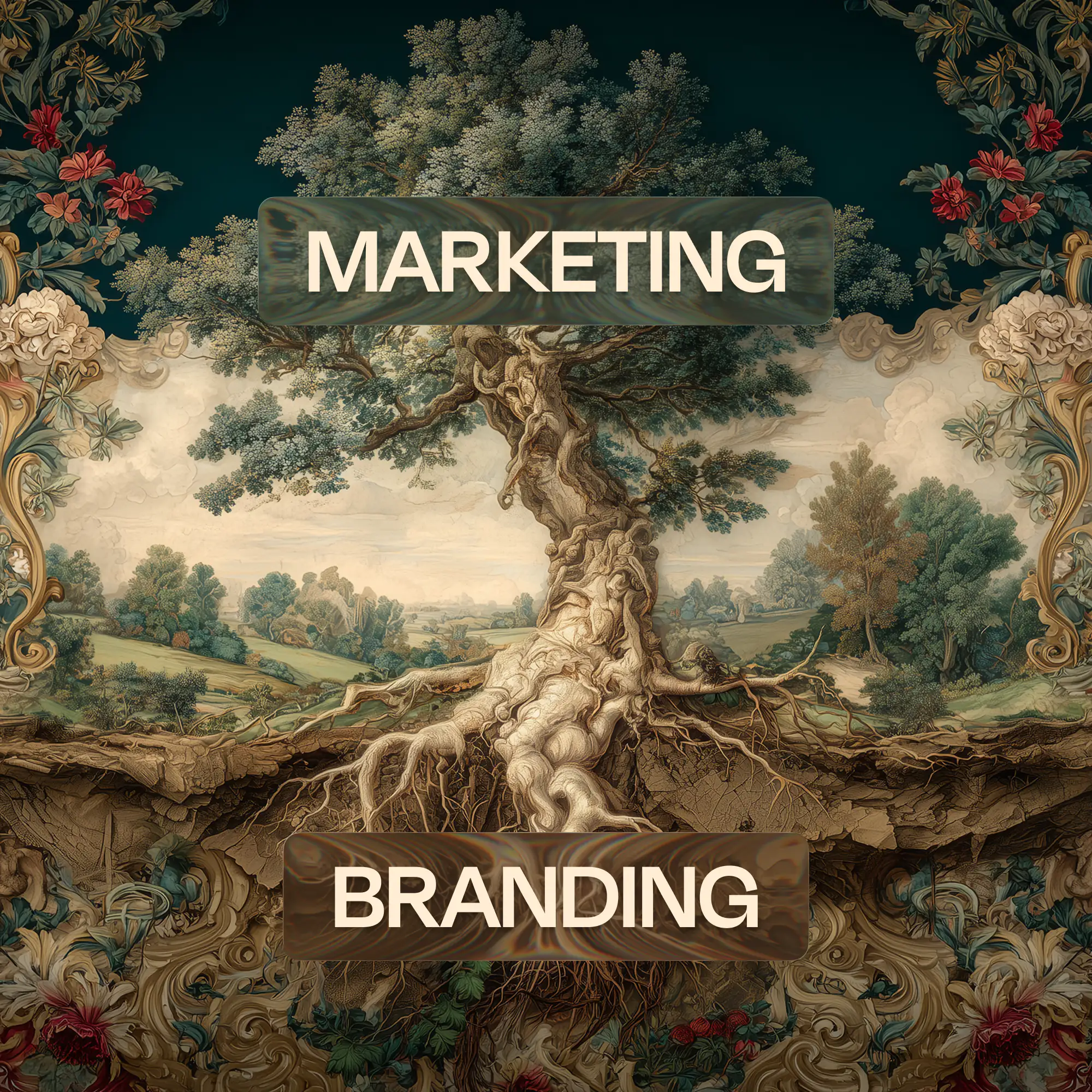
How branding amplifies marketing:
- Recognition: People are more likely to click ads from brands they recognize
- Trust: Established brands convert leads faster and with less friction
- Referrals: Strong brands generate word-of-mouth, reducing marketing dependency
- Content performance: Branded content gets higher engagement and sharing
- Pricing power: Brands can charge more, improving margins and marketing ROI
How marketing strengthens branding:
- Visibility: Marketing campaigns build brand awareness at scale
- Reinforcement: Consistent marketing messages strengthen brand positioning
- Proof: Successful campaigns and customer testimonials build brand credibility
- Evolution: Marketing data helps brands understand what resonates with audiences
- Competitive defense: Active marketing prevents competitors from owning your space
Branding is building a reputation as a trusted expert. Marketing is letting people know you're available to help them right now.
The ROI of Investing in Both
Still skeptical about branding's financial impact? The data tells a compelling story:
- A Lucidpress study found consistent branding can increase revenue by 33%. A 10% increase over their 2016 report.
- 68% of companies report that if their brand was consistently maintained, they would expect to have a 10-20% increase in overall growth according to a research by Marq.
- Increasing customer retention rates by a mere 5% can boost profits by 25% to 95%, according to Research by Bain & Company
- Research from LinkedIn B2B Institute finds that B2B businesses grow best when allocating 46% of the budget to brand-building activity and 54% to activation marketing.
- LinkedIn research with Peter Field and Les Binet shows that campaigns that deliver on brand metrics have 4x the impact on a business's bottom line than those that don't.
The compound effect: Branding is an appreciating asset. Every dollar invested in building your brand increases the efficiency of your marketing dollars. Over time, strong brands spend less on marketing to achieve the same results.
How to Invest in Both Strategically
You don't need an unlimited budget to invest in both branding and marketing. You need strategic prioritization.
For early-stage businesses (limited budget):
Start with branding foundations:
- Define your positioning, values, and differentiation
- Create a strong visual and verbal identity
- Build a professional website that communicates your brand
- Invest in marketing that also builds brand (content marketing, thought leadership)
For growth-stage businesses (scaling revenue):
Balance branding and marketing:
- Maintain consistent brand expression across all marketing channels
- Invest in brand awareness campaigns alongside conversion campaigns
- Use customer feedback to refine brand positioning
- Build brand equity through PR, partnerships, and community
For established businesses (market leadership):
Leverage brand strength:
- Use brand equity to expand into new markets or products
- Invest in brand evolution to stay relevant
- Focus marketing on retention and lifetime value
- Turn customers into brand advocates
The 60/40 rule: A general guideline is spending 60% on marketing (performance, campaigns, lead generation) and 40% on branding (identity, positioning, awareness, experience). Adjust based on your business stage and market position.
Common Branding and Marketing Mistakes
Mistake 1: Inconsistent branding across marketing channels
Your brand should look, sound, and feel the same whether someone encounters you on LinkedIn, your website, or a trade show booth. Over 60% of organizations report that materials are always, often, or sometimes created that don't conform to brand guidelines, according to research by Lucidpress and Demand Metric.
Mistake 2: Measuring only short-term marketing ROI
If you only track immediate conversions, you'll underinvest in branding and long-term marketing. Brand campaigns do their work over the course of several years. Their effects accumulate as influential memories build up, as per research by LinkedIn, making future demand generation far more efficient.
Mistake 3: Copying competitor marketing without differentiated branding
Your marketing might look like everyone else's if your branding isn't distinct. Strong branding gives your marketing a unique voice that cuts through noise.
Mistake 4: Rebranding too frequently
Brands need consistency to build recognition. Constantly changing your identity confuses customers and wastes past brand-building investment.
Mistake 5: Treating branding as a one-time project
Branding isn't "complete" after you launch a new logo. It's an ongoing practice of reinforcing who you are through every business decision and customer interaction.
Real-World Success Stories
HubSpot: Building brand authority in B2B SaaS HubSpot created the category of "inbound marketing," effectively owning those two words and making any competitor who used the term reinforce HubSpot's value proposition. This was HubSpot’s Mental Market Monopoly. HubSpot ranks ahead of larger peers like Salesforce and Adobe in AI-powered search visibility, being mentioned frequently and early in ChatGPT and Google AI Mode responses. This brand strength translates directly to business performance; HubSpot had roughly 248,000 paying customers by Q4 2024 and generated $2.63B in revenue, reflecting strong adoption driven by brand recognition and trust.
Starbucks: Values-based branding driving customer loyalty Starbucks' Shared Planet Initiative demonstrates a commitment to using ethically sourced coffee beans grown responsibly across all franchises. As environmental and social concerns rank high on consumers' priority lists, customers feel an affinity with the brand based on its values and can trust that Starbucks will take the promised action. This values-based branding allows Starbucks to maintain premium pricing while building deep customer loyalty.
Getting Started: Your Next Steps
If you've been focused primarily on marketing and questioning whether branding investment is worthwhile, here's how to move forward:
Step 1: Audit your current brand strength
- Do people in your market recognize your company name?
- Can you clearly articulate what makes you different from competitors?
- Is your brand identity consistent across all touchpoints?
- What do customers say about you without prompting?
Step 2: Calculate the branding tax you're paying
- Compare your CAC to industry benchmarks
- Analyze conversion rates from awareness to purchase
- Review customer lifetime value and retention rates
- Assess price sensitivity in lost deals
Step 3: Start with high-impact branding investments
- Clarify your positioning and messaging
- Ensure visual consistency across marketing materials
- Improve your website to reflect your brand properly
- Train your team to deliver on your brand promise
Step 4: Integrate branding into marketing
- Align all campaigns with brand positioning
- Use consistent language and visual identity
- Balance direct response with brand-building content
- Measure both brand lift and conversion metrics
Step 5: Commit to the long game
Brand building takes time. The companies with the strongest brands invested consistently over years, not months. Start now, stay consistent, and watch your marketing ROI improve as your brand equity grows.
The Bottom Line
Sustainable growth rarely comes from focusing on branding or marketing in isolation. It comes from understanding how the two support and strengthen each other over time. Marketing creates visibility and momentum in the present. Branding shapes how that momentum is received, remembered, and trusted.
When branding and marketing are developed together, each effort builds on the last. Campaigns become more effective because trust already exists. Customer relationships last longer because the experience feels consistent and intentional. Over time, this creates a compounding effect, making growth easier to sustain.
The businesses that perform consistently well are not choosing one discipline over the other. They are making deliberate, long-term investments in both and designing them to work as a single, connected system.
The question is not whether to invest in branding or marketing. The real question is whether you want growth that is temporary and expensive, or growth that compounds over time. The most resilient businesses design branding and marketing as one integrated system from the start.
Frequently Asked Questions
Q: How long does it take to build a brand?
Brand building is ongoing, but you can establish a strong foundation in 3-6 months. Meaningful brand recognition in your market typically takes 12-24 months of consistent effort. However, brand equity compounds over time; the longer you invest consistently, the stronger your brand becomes and the more efficient your marketing gets.
Q: Can small businesses afford to invest in branding?
Yes. Branding doesn't require a Fortune 500 budget. Start with strategy: clarify your positioning, values, and differentiation. Then ensure consistency in how you present yourself. Even a small business can build a memorable brand through authentic storytelling, reliable customer experience, and consistent visual and verbal identity.
Q: How do I measure branding ROI when it doesn't directly generate leads?
Track brand awareness (do people know you?), brand consideration (do they consider you when ready to buy?), brand preference (do they choose you over alternatives?), and brand loyalty (do they come back?). Also monitor indirect metrics: declining CAC over time, improving conversion rates, higher average deal values, and increased customer lifetime value all indicate growing brand strength.
Q: Should I rebrand if my current brand isn't working?
Not necessarily. First, audit whether the issue is your brand strategy or its execution. Sometimes the brand foundation is solid, but marketing execution is inconsistent or weak. Rebranding is expensive and resets brand equity, so only do it if your positioning is fundamentally misaligned with your market or if you've significantly evolved your business model.
Q: What's the difference between a logo and a brand?
Your logo is a visual symbol: one small piece of your brand. Your brand is the entire perception people have of your company: your values, personality, promise, reputation, and the emotions they feel when interacting with you. A great logo helps people recognize your brand, but it doesn't create the brand itself.
Q: How much should I spend on branding vs marketing?
LinkedIn B2B Institute research suggests B2B businesses grow best when allocating 46% of the budget to brand-building activity and 54% to activation marketing. For a more general framework, consider 60% on marketing (campaigns, ads, content, lead generation) and 40% on branding (strategy, identity, awareness, experience). Early-stage companies might start with heavier branding investment to build a foundation, while established brands might shift more toward marketing.
Q: Can I build a brand purely through social media marketing?
Social media can be a powerful branding channel if used strategically, but branding requires consistency across all touchpoints: your website, customer service, product experience, sales process, and more. Social media marketing without a coherent brand strategy often creates noise without building lasting equity.
Q: What if my competitors don't invest in branding and still succeed?
Some businesses succeed despite weak branding through superior products, pricing, or distribution. However, they're leaving money on the table and are vulnerable to competitors with stronger brands. As markets mature and competition intensifies, brand differentiation becomes increasingly critical for sustainable growth.
Q: How do I convince leadership to invest in branding when they only care about leads?
Show the data: compare your CAC, conversion rates, and customer lifetime value to benchmarks. For organizations with brand consistency issues, the estimated average revenue increase from always presenting the brand consistently is 23%. Present branding as a strategic investment that makes marketing more efficient, not as competing with marketing. Position it as lowering the cost per lead over time rather than an expense with no return.
Q: Is branding only for B2C companies, or does it matter in B2B too?
Branding is critical in B2B, arguably more so than B2C. B2B purchases are higher-stakes, involve multiple decision-makers, and require significant trust. Strong B2B brands like Salesforce, HubSpot, and AWS command premium pricing, shorter sales cycles, and higher customer loyalty because they've invested heavily in both branding and marketing.
