
TL;DR:
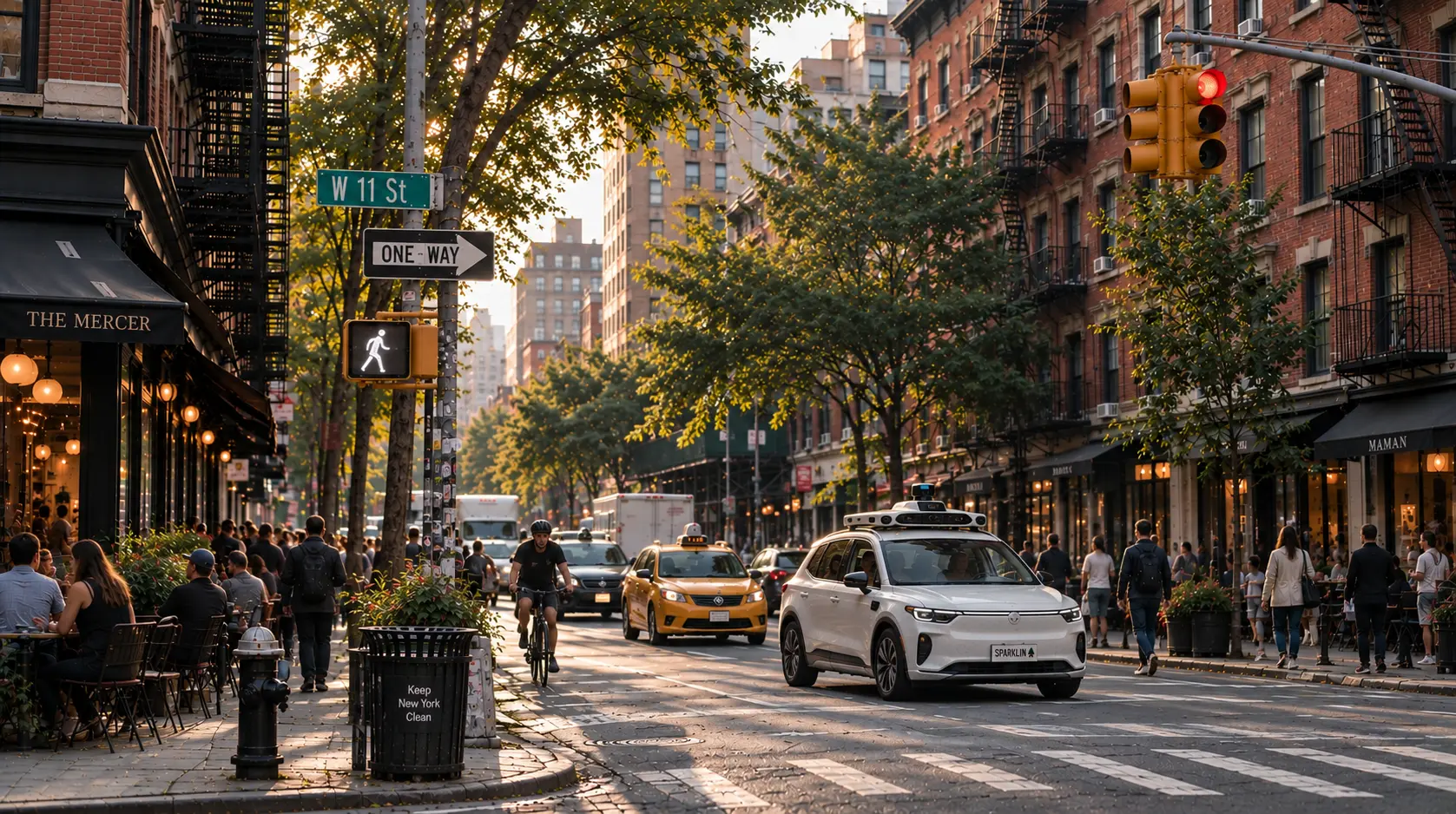
Removing the human driver changes more than the car. It separates the passenger’s destination from the vehicle’s destination, which means cars no longer have to park where their passengers stop. That could change parking demand, turn curbs from storage space into pickup and exchange space, and create new traffic as empty autonomous vehicles move between passengers, charging and places to wait. Autonomy also separates time spent traveling from time spent driving: a journey can take exactly as long while requiring something very different from the passenger.
The effects reach beyond parking. Human drivers have spent more than a century reading pedestrians, negotiating with other road users and interpreting traffic infrastructure. Autonomous vehicles therefore have to perform some of that work differently, while other parts may shift into the infrastructure around them. The larger question is how much of the modern city has quietly been designed around the assumption that a human would always be behind the wheel.
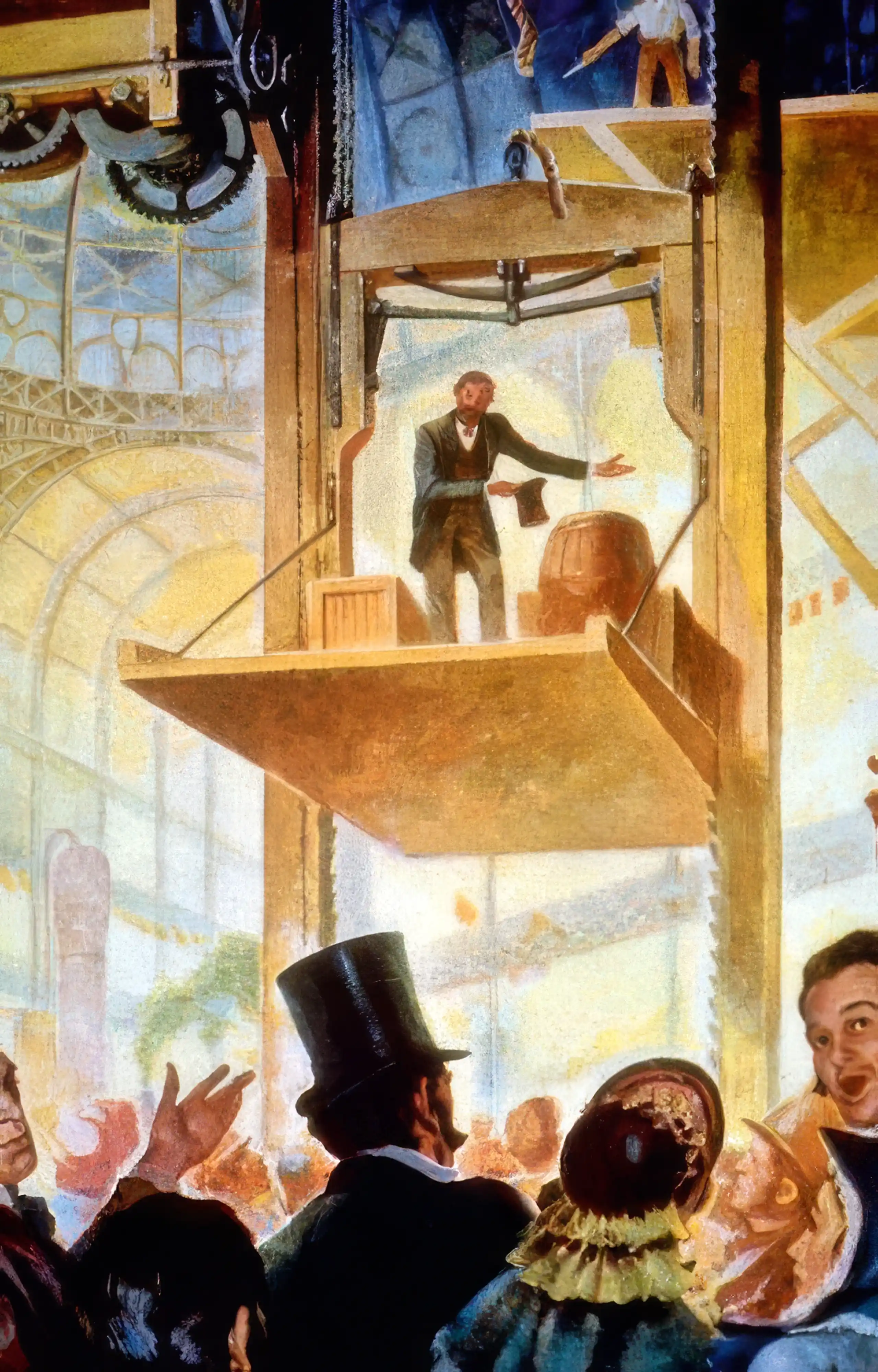
On a May afternoon in 1854, visitors to the Exhibition of the Industry of All Nations in New York could watch a man rise above them on an open platform. His name was Elisha Otis, and what he did next did not leave much room for a malfunction.
He had the rope holding the platform cut.
Machines capable of lifting people and things vertically were not new. The problem was what happened when the rope broke. Otis had devised a safety mechanism that caught the platform instead of allowing it to crash to the ground. At New York’s Crystal Palace, the platform dropped, the mechanism caught it, and Otis reportedly reassured the crowd that all was safe.
Three years later, the first commercial Otis passenger elevator was installed in E.V. Haughwout’s department store in Manhattan. It traveled at about 40 feet a minute, which would feel almost comically slow today. But speed was hardly the main concern in 1857. People were being asked to step into a machine, leave the ground and trust that the machine would bring them back down again.
Before elevators could change buildings, people had to be willing to get into them.
I think about this surprisingly often because of a question I like asking people we’re considering hiring at Sparklin:
What is the most important thing to think about when designing an autonomous vehicle?
Almost everyone says trust.
A car without a human driver asks for a similar surrender of control, except that the world around a car is considerably less predictable than an elevator shaft. A child can run onto the road. A police officer can hold up a hand. Construction can turn a familiar street into something the car has never encountered before. The passenger has to believe that the vehicle has seen what they have seen, and perhaps things they haven’t.
Driverless taxis themselves are no longer new. Waymo has been carrying paying passengers without anyone behind the wheel for years, and what once looked experimental is now a way for people to get around parts of several American cities. Waymo’s vehicles, however, still retain much of the physical architecture of cars designed for people to drive.
On September 3, 2026, Tesla began offering Cybercab rides in limited areas of Austin. Cybercab makes the removal of the driver physically obvious. It has no steering wheel or pedals, and there is no visible provision for the passenger to take over and drive. The following day, the National Highway Traffic Safety Administration opened an Audit Query into Tesla’s self-certification that Cybercab complies with applicable federal motor vehicle safety standards, including the basis for certifying a vehicle that lacks traditional human controls.
Let’s fast forward thirty-six years, to 1890, when the Pulitzer Building opened in New York. At 309 feet to the top of its dome, it was the tallest office building in the world. Its publishers advertised the new offices by asking prospective tenants how many valuable hours they had lost waiting for elevators elsewhere. Tenants in the Pulitzer Building were promised that they would never have to wait a minute.
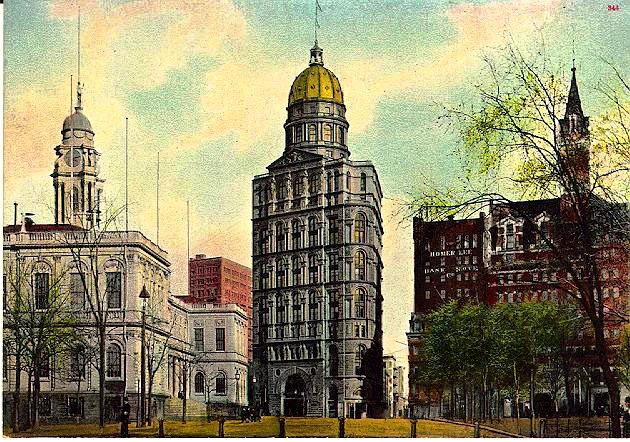
Recall how Otis had stood above a crowd demonstrating that an elevator would not fall when its rope was cut? By 1890, New Yorkers were comfortable enough with elevators that waiting a few minutes for one had become a problem worth advertising against.
Nobody conducting design research around Otis’s platform in 1854 was likely to discover elevator waiting time as a problem. Elevators had to become trusted, buildings had to change around them and elevator travel had to become ordinary before waiting a few minutes could become annoying.
Elevators would go on to change buildings in more surprising ways. We’ll come back to one of them in a different essay.
For now, there is a car sitting outside your office.
Why does your car come to work with you?
Suppose you drove to work this morning.
Your car is probably sitting somewhere nearby while you read this. Perhaps it is three floors below you, under fluorescent lights, between two concrete pillars. It will stay there while you answer emails, have lunch and sit through meetings. Eight or nine hours later, you will return and ask the car to move again.
A 2024 analysis of USGS data on parking land estimated about 1.31 billion parking spaces for 276 million registered vehicles in the United States. That is nearly five spaces for every vehicle.
A car can only occupy one of those spaces at a time. The problem is that the city does not know which one you will need at any given time.
You need a place to have that car near your home. Another space near work, another near a supermarket and another near a restaurant. Those spaces are shared by thousands of people, but enough parking has to exist in enough places for driving and parking to remain convenient.
Los Angeles County has an estimated 3.3 parking spaces for every car. Together, parking occupies roughly 14 percent of the county’s incorporated land, about 1.4 times the area occupied by roads.
Your car, however, does not actually need to spend the working day beside your office. It is there because you drove it there.
Removing the need for a human driver separates the destination of the passenger from the destination of the vehicle. What happens next depends heavily on whose vehicle it is.
Your autonomous car might drop you at work, return home and come back that evening. The office loses one parked car, but the road gains two empty journeys. A shared robotaxi could leave you and immediately find its next passenger. A pooled service could carry several people traveling in the same direction.
All three may look like self-driving cars from the back seat. But they can produce very different traffic patterns from the street.
Singapore is already exploring one version of this possibility. Autonomous shuttles in Punggol connect residential areas with MRT stations and neighborhood amenities as part of the public transport network. Autonomy, in other words, does not have to produce a better taxi. It can also change the boundary between a car and public transportation.
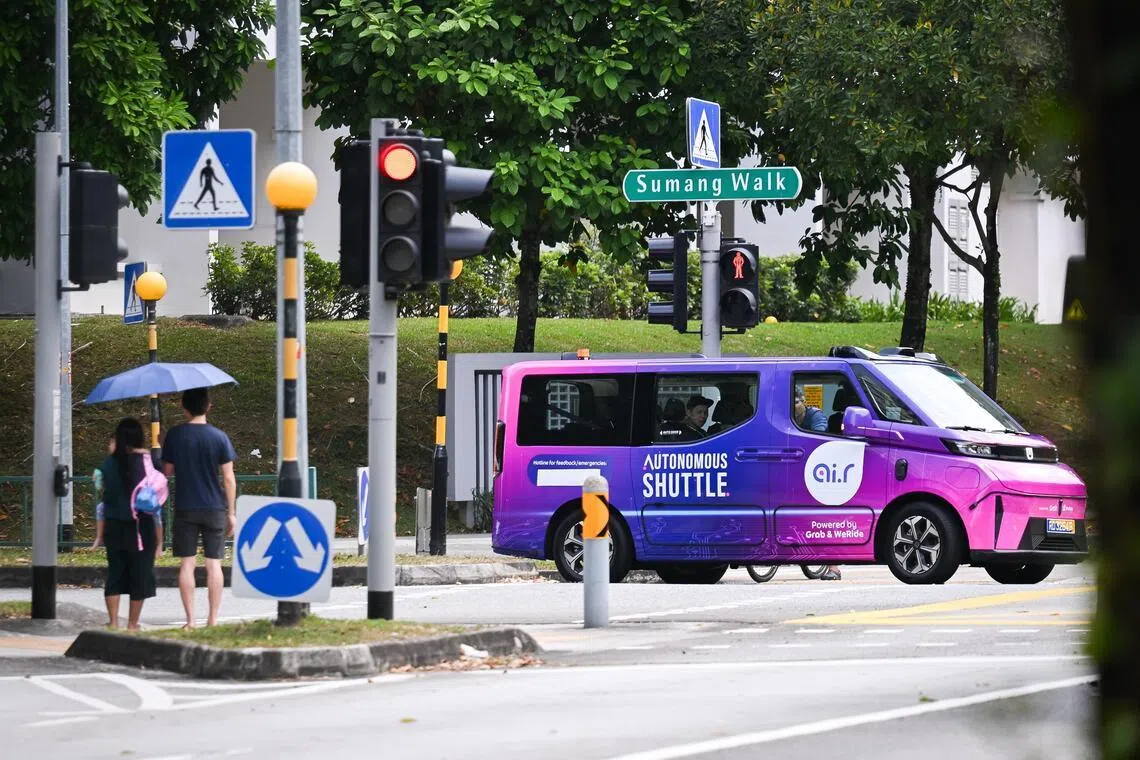
None of this makes parking disappear. Cars still need somewhere to exist when nobody needs them. What changes is the old requirement for a car to wait wherever the person who drove it happens to be.
When parking becomes pickup
Seattle encountered a version of this problem in 2019 without needing a single autonomous vehicle.
Late at night in Capitol Hill, thousands of people would leave bars, restaurants, clubs and theaters and request Uber or Lyft rides at roughly the same time. Cars converged on the neighborhood while passengers tried to find them, creating congestion that interfered with traffic, police and emergency access.
At midnight, the immediate problem wasn’t where all those cars would park. It was where thousands of cars and passengers could find one another.
Seattle created four designated late-night pickup zones. People requesting rides inside a geofenced area were directed toward these locations instead of having every vehicle collect every passenger from wherever they happened to be standing. A few months later, the city reported smoother traffic circulation, faster crowd dispersal and better police access.
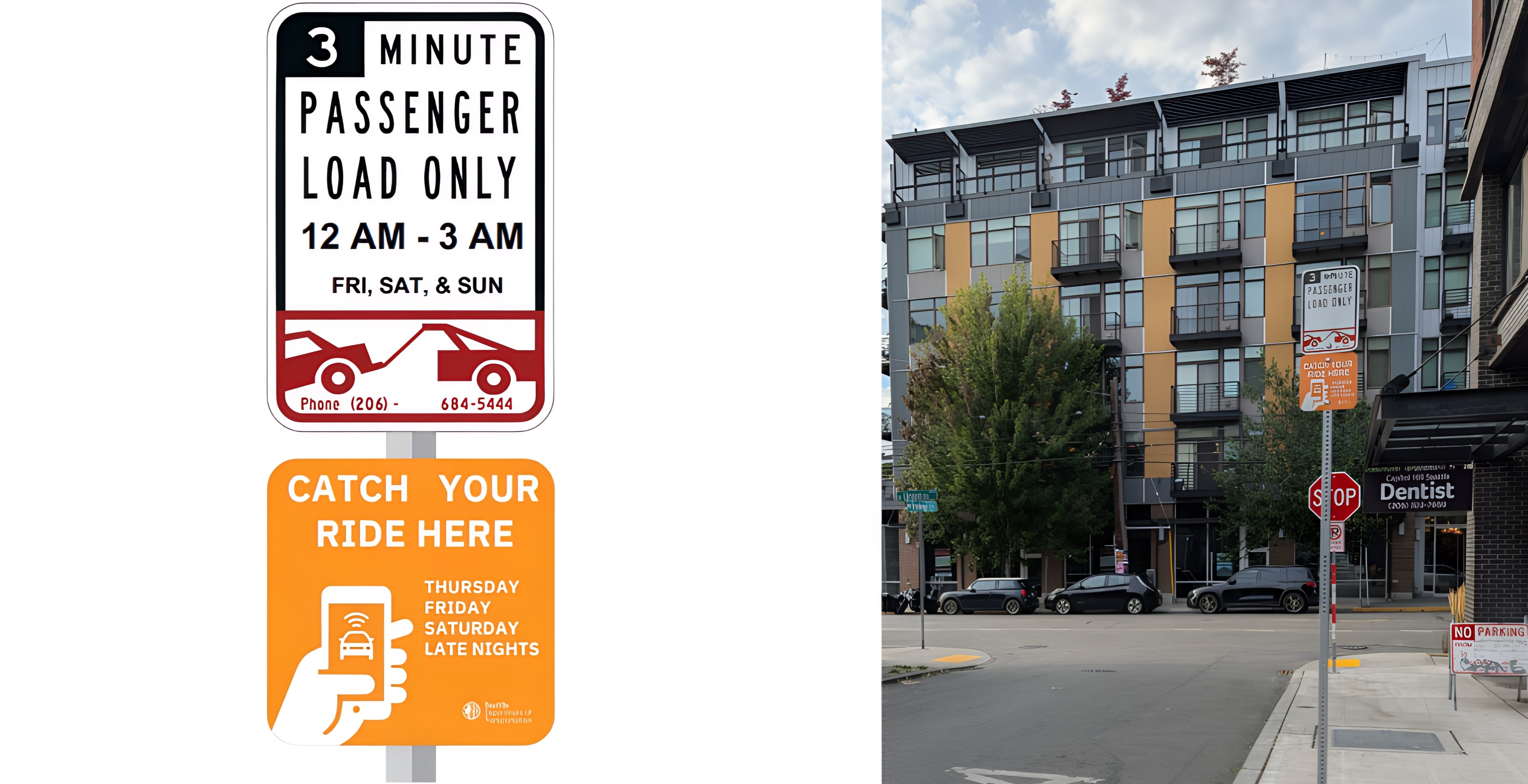
A piece of curb that had traditionally been useful for storing a vehicle was now being used to exchange passengers.
Autonomous fleets make that distinction between storage space and exchange space a lot more important. An office may need fewer places for vehicles to sit for eight hours and more room for vehicles arriving and leaving throughout the day. Restaurants, schools, theaters and apartment buildings could face variations of the same problem.
Once a passenger gets out of a shared autonomous vehicle, the empty vehicle still needs somewhere to go.
A 2026 study modeled a hypothetical fleet of 1,700 shared autonomous vehicles making about 68,000 daily trips in San Francisco. When researchers prevented empty vehicles from waiting at the curb between trips, daily vehicle travel increased by more than 200,000 kilometers, nearly 60 percent.
Preventing the vehicles from waiting did not eliminate the need for them to be somewhere. Sending empty vehicles somewhere else to wait creates traffic getting there, while preventing them from waiting can encourage them to circulate. A fleet might therefore require fewer vehicles overall while putting more kilometers on each one.
Garages, office basements, parking lots and curbs were all designed partly around vehicles having to remain near the people who drove them.
The driver was part of the interface
Imagine you are about to cross a narrow street and a car is approaching.
You look at the car. Perhaps it begins slowing early enough that you step forward. Perhaps the driver waves you across. The car might creep forward slightly and you decide to wait. Sometimes you make eye contact with the driver, but often you don’t need to. You have learned to infer intention from the vehicle’s speed, distance and position, along with small pieces of human behavior that are difficult to name because we interpret them so routinely.
The same kind of negotiation happens throughout a journey. A delivery van blocks half a narrow street and two drivers somehow work out who should go first. A police officer raises a hand even though the traffic light above the intersection is green. A football rolls into the road and a driver begins slowing before the child chasing it appears.
So when the human driver disappears, the car loses more than the person operating the steering wheel and pedals. It also loses someone who had been interpreting the city and communicating with the people around the vehicle.
Autonomous vehicles have to replace at least some of that work. This has created an area of research into external human-machine interfaces, or eHMIs. Researchers and carmakers have experimented with displays, colored lights, text, symbols and other signals that tell pedestrians that a vehicle has seen them or intends to yield. Beijing has taken autonomous driving beyond the vehicle, equipping 600 square kilometers of its demonstration zone with smart roadside infrastructure.
From inside the car, the driver was the operator. From outside, the same person was part of the interface between the vehicle and everyone around it. The driver was part of the city’s interface.
Not every piece of communication needs a technological replacement. Pedestrians already use the movement of a vehicle, including its speed and deceleration, to decide when to cross. An autonomous vehicle may communicate simply by slowing in a predictable way rather than by growing a digital pair of eyes on its hood.
Autonomous vehicles can perceive the street differently from a human driver. Cameras and other sensors can observe several directions at once, while connected vehicles could eventually exchange information that no person inside either vehicle could see directly.
What is the most important thing to think about when designing an autonomous vehicle?
Trust is still a very good answer.
Otis had to solve the problem of people believing an elevator would not fall before anyone could discover what elevators would eventually do to buildings. If people do not trust autonomous vehicles enough to use them, many of the changes we have been discussing may never happen either.
Trust, however, gets us only as far as adoption.
Once autonomous vehicles become ordinary, the car no longer has to stay with its passenger.
For most of the car’s history, one person inside has had a different job from everyone else. While the passengers could talk, read, work, sleep or look out of the window, the driver had to drive. In an autonomous car, the vehicle takes over that job. Everyone inside gets to be a passenger.
A two-hour journey may still take two hours. But nobody inside has to spend those two hours driving.
During those same two hours, the driver was reading the city. Pedestrians, road signs, lane markings and traffic lights all had to be understood by the person controlling the vehicle.
We have spent more than a century making roads readable to the people driving through them. Now, for the first time, the vehicle doing the driving may not need to read the road in the same way a person does.
Why does a traffic light need to be a light?
AV & City is a Sparklin research series exploring autonomous mobility through design, technology, behavior and strategy, and what emerging technologies make possible for products, infrastructure and cities.

 Hide reactions